

You’re the captain. Flo’s the navigator.
Flo does the page testing your team never has time for.
Turn more of your visitors into orders. Flo comes up with new versions of your pages, builds them in your brand and runs them on your existing links, with no redirect. By default, nothing goes live without your yes.
Watch the film (1:27) See the headway growHeadwayThis month your team launched a dozen new ads. Most of them point at the same product page.
On Meta you keep launching new ads and move spend to the ones that work. Your site doesn’t change that fast. You pay for every click, and the shopper who tapped your gift ad lands on a page that never once mentions gifting.
A version of your page that carries on from the ad could turn more of those clicks into orders. But someone has to think it up, build it, change the ad links and wait weeks for a result.
And the pages you do build pile up. Past a couple, it’s hard to tell which are live and which still show last month’s offer.
So the ideas sit in a doc, and the ads keep sending people to the page you built months ago.


How it works
Flo keeps page ideas flowing while your team runs the ads.
Flo runs your pages the way you run your ads. It keeps launching new ones and puts your traffic behind what sells.
-
Flo reads your ads, your reviews, your competitors’ pages and recordings of how people use your site. Then it plots what to test next and tells you why in Slack.
-
Pages are made from your own fonts, colors, photos and products. Prices and offers stay in sync with your store. Flo adds no claims or images of its own.
-
No subdomain and no redirect. Your ads keep their links, so you never edit an ad and Flo never sends an ad set back into Meta’s learning phase. Behind each link Flo runs several pages and sends each audience to the page that sells best to it.
-
A share of visitors, the holdout, keeps seeing your current page, so every result is measured against it. Pages that don’t sell get dropped.
 Flo
Flo posts page ideas, previews and results for hollisclay.com here.
Monday
- Gift ad38% of clicks this week
- RecordingsMost leave before scrolling
- Reviews112 mention gifts
Idea for the gift ad: most of its visitors leave the mug page before they scroll, and 112 reviews mention gifts. I’d test a page that leads with gifting. Build it?
Your current page · hollisclay.com/products/everyday-mugMade by hand.Stoneware, glazed in small batches. 12 oz.
On it. I’ll post a preview here.
Gift page built from hollisclay.com. Waiting for your OK to go live.
HOLLIS CLAY
THE GIFT EDIT
Handmade stoneware, glazed in small batches. 12 oz.
Shop the gift mug · $38$38 from your store

- ★★★★★Bought it for my sister. She uses it every morning.
- ★★★★★Arrived wrapped, with a handwritten card.
- ★★★★★My third one as a present this year.
- Fonts and colors
- Product photos
- Price, $38, synced
Approved. Going live on the same link.
Tuesday
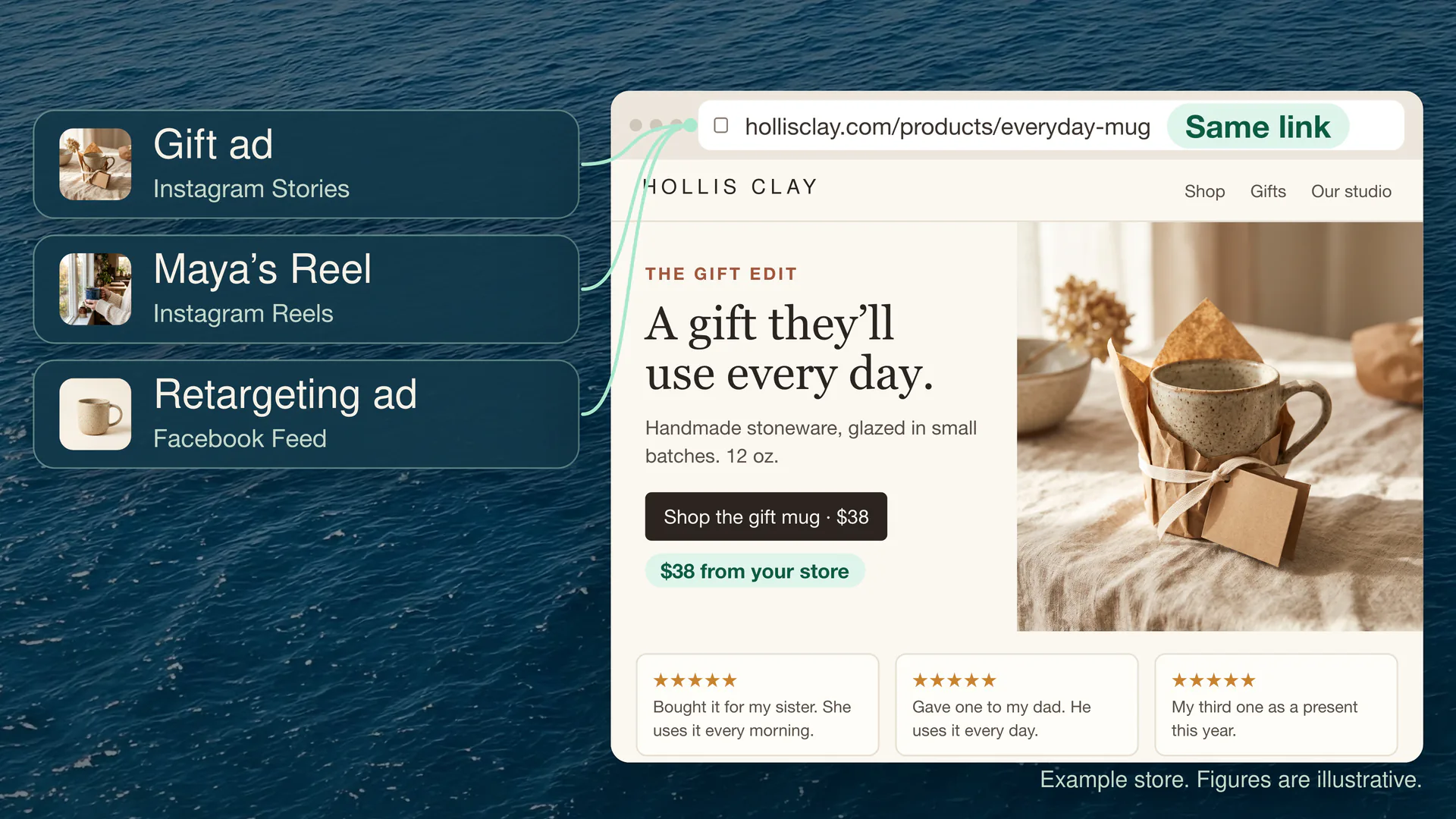
The gift page is live alongside the page for Maya’s Reel.
hollisclay.com/products/everyday-mugSame link
-
From the gift adInstagram Stories
 A gift they’ll use every day.
-
From Maya’s ReelReels
 A slower morning.
-
HoldoutSees your current page
 Made by hand.
- No ad links changed
- Measured against your current page
Next Monday
So far, the gift page has taken 2.9 orders per 100 gift-ad visitors. Your current page has taken 2.1.
Orders per 100 visitors from the gift ad
Your current page2.1
Gift page2.9
Next idea: a page for your set-of-four ad. Build it?

Hollis Clay is an example store. Figures are illustrative.
Captain’s call: how much Flo does on its own.
- Suggest
- Flo recommends the next step and you take it.
- Ask first
- Flo builds the page and waits for your yes.
- Autopilot
- Flo publishes inside limits you set.
New stores start on Ask first.
Watch one idea sail from Slack to a live page.
Example store. Figures are illustrative.
Read the film as text
This month your team launched a dozen new ads.
On screen: twelve ads for an example store, Hollis Clay, arrive one after another, and a counter reaches “12 new ads this month”.
Almost all of them land on a page you last changed months ago.
On screen: a line runs from each ad to the same product page, the Everyday Mug at $38, at hollisclay.com/products/everyday-mug. A stamp lands on the page: “Last changed 8 months ago”.
New pages could help, but nobody has time to think them up and build them.
On screen: a shared doc, “Page tests to try”, with its first idea added 6 weeks ago. Five ideas wait in it, from 6 weeks to 2 weeks old: a gift page for the gift ad, a page for Maya’s Reel, a set-of-four page, a faster page on phones, and reviews up top. Its owner is Unassigned.
Flo is an agent. It takes that work off your team.
On screen: the doc moves aside, its owner changes to Flo, and the first idea is marked In progress. Beside it are the Flo logo and the same two sentences.
It reads your ads, your reviews and recordings of your site. Then it brings you an idea, like this one.
On screen: a Slack message from Flo lists three sources, each lit as the voice names it: the gift ad, with 38% of this week’s clicks; reviews, 112 of which mention gifts; and recordings, where most visitors leave before scrolling.
A hundred and twelve reviews mention buying the mug as a gift, and the page never says so.
On screen: the message reads “Idea for your gift ad: 112 reviews mention buying the mug as a gift. The page never says so. Build a gift page?” Someone presses Build it.
Say yes, and it builds the page from your own photos, products and prices.
On screen: a preview of the gift page takes shape, headed “A gift they’ll use every day.”, with the mug at $38 and three reviews from people who bought it as a present. Three checks tick off: fonts and colors, photos, and products and prices, all taken from the store’s site. Then, with no voice, Flo posts in Slack: “Built a gift page from your site. Waiting for your OK.” Someone presses Approve, and the message adds “Live on your link.”
It goes live on the links your ads already use, so you never edit an ad.
On screen: three ads, the gift ad (Instagram Stories), Maya’s Reel (Instagram Reels) and a retargeting ad (Facebook Feed), link to the same address, hollisclay.com/products/everyday-mug, marked “Same link”. A check reads “No ad links changed”.
Each click gets the page picked for its ad, and a share of visitors still sees your current page, so every result is measured against it.
On screen: a visitor from each ad gets the page made for that ad: the gift page, a page for Maya’s Reel, and a page that repeats the retargeting ad’s line, “Still thinking it over?”. One visitor, marked Holdout, sees the current page. A second check reads “Measured against your current page”.
Every week, Flo keeps what sells. Here the gift page sold more than your current page.
On screen: Flo’s report in Slack, “Last week on the mug page”: orders per 100 visitors from the gift ad, 2.1 on the current page and 2.9 on the gift page, marked “Illustrative figures”.
Then it starts on the next idea.
On screen: a second message, “Next idea: a page for your set-of-four ad. Build it?”, drawn from the set-of-four ad and 41 reviews that mention buying more.
Nothing goes live until you approve it, unless you choose Autopilot.
On screen: a setting for how much Flo does on its own, with three choices: Suggest, Ask first and Autopilot. It rests on Ask first, with the line “Ask first: Flo builds the page and waits for your yes.” Autopilot is circled when the voice names it.
Note: with Autopilot on, Flo publishes inside limits you set. New stores start on Ask first.
Flo. The page testing your team never has time for.
On screen: the Flo logo and the same line, over a ship in a harbor.
Hollis Clay is an example store. Figures are illustrative.

Headway
Every page that wins sets the course for the next one.
The first page Flo builds probably won’t be the big winner. Each page teaches Flo more about your customers, and what they want in November isn’t what they want after Christmas. The holdout stays anchored to the page you started with. The open water between the two lines is your headway.
Start with one campaign or part of your traffic.
Add more when the results hold up.
In the first week you connect Shopify and Meta, and Flo picks where to start, usually your top-spending ad or a theme several ads share. You approve the first pages and choose how much of your traffic they get. Flo keeps improving them from heatmaps and recordings.
- Visitors don’t wait on a redirect.There’s no second page to load.
- Your tracking keeps working.The same pixels fire on Flo’s pages as on the rest of your store.
- Meta, Google, TikTok and AppLovin.Flo works with traffic from all four.
- Bring your own pages.Pages you build in Claude, ChatGPT or other tools run on the same links as Flo’s and are measured the same way.
Pricing
No subscription. You pay only on sales through pages Flo runs.
Flo’s standard pricing is usage-based and billed monthly in arrears. There is no base subscription or monthly minimum.
Every page is measured against your current page, so you can check the bill against what Flo’s pages added.
Processed GMV is revenue attributed to the optimization group, net of refunds and excluding holdout traffic, taxes, shipping, tips and gift cards.
- First $50,000 of monthly Processed GMV
- Free
- $50,000 to $400,000
- 2%
- $400,000 to $1.6 million
- 1.5%
- Above $1.6 million
- 1%
These are marginal brackets, not one rate applied to the entire amount. On $500,000, the first $50,000 is free, the next $350,000 at 2% is $7,000 and the last $100,000 at 1.5% is $1,500. At $500,000 of Processed GMV, the bill is $8,500.
Questions
What founders and growth leads ask first.
Is Flo an A/B testing tool?
It can run your A/B tests without the redirect that split-URL tests add. The bigger use is to run your pages the way you run your ads. Flo keeps launching new pages behind the same link, drops the ones that clearly don’t sell and builds on the ones that do. A share of visitors, the holdout, keeps seeing your current page, so every page is measured against it.
Does Flo build a page for every ad?
No. It starts with your top-spending ads and the themes across them, because each page needs enough traffic to call a result. Each new page starts from what the earlier ones taught it.
How much of my team’s time does Flo take?
Someone on your team says yes or no in Slack to each idea and each finished page. If you have an idea of your own, ask Flo in Slack to “make a version of this page that leads with the reviews and send it 10% of traffic.” While we set Flo up with you, our team handles anything unusual.
Is Flo a landing page builder?
It builds new versions of your pages. It also charts what to build next, runs each one on the links your ads use and measures it against your current page.
We build our own pages in Claude. What does Flo add?
Keep building them. A page made in Claude still has to run on the links your ads use and be measured against your current page. Flo does that for pages you bring as well as its own, and in the weeks nobody has time to build, it brings the next page itself.
Does it slow the page down?
There’s no redirect, so visitors don’t wait for a second page to load. On one store we measured in July and August 2026, a split-URL test’s redirect added a median 2.7 seconds on iOS and 3.2 on Android.
How do we know a page is working, and how soon?
Flo measures every page against the holdout, the share of visitors who keep seeing your current page. Your pixels fire on Flo’s pages as they do on the rest of your store, so orders also land in the analytics you use today. How soon depends on your traffic.
What if one of Flo’s pages does worse than ours?
Flo drops it. You also choose how much traffic new pages get, and you can start with part of one campaign. Everyone else keeps seeing your current page.
Why a percentage instead of a flat fee?
A flat fee costs the same whether the pages Flo runs get a sliver of your traffic or most of it. A percentage keeps a small test cheap, and visitors who keep seeing your current page aren’t billed.
What stops Flo from saying something we can’t say?
Flo writes from your site and your product data and adds no claims or images of its own. Unless you turn on Autopilot, it asks before a page goes live.
What happened to Lutiq?
We renamed it. Lutiq is now Flo, with the same team and the same prediction system. The agent that does the page work is new.

See what Flo would test first on your store.
Flo is coming aboard a few stores at a time. There is no base subscription or monthly minimum. The first $50,000 of monthly Processed GMV is free.
Request an invite and we’ll set up Flo with you.